
For all the attention AI receives in healthcare, the most important question is “Can it actually make clinical research better?”
Clinical trials operate in an environment where speed matters, but so do accuracy, traceability, scientific rigor, and patient safety.
AI cannot simply be dropped into a workflow and expected to solve every problem. The strongest use cases begin with the right data and a clearly defined purpose, supported by validation and human oversight from the start.

The misconception about AI is that the hard part is training the model or building the AI models. I think the hard part is the validation.”
Vish Srivastava, Co-Founder & CEO, Century Health
Here’s a glimpse into the future of AI in clinical trial research.

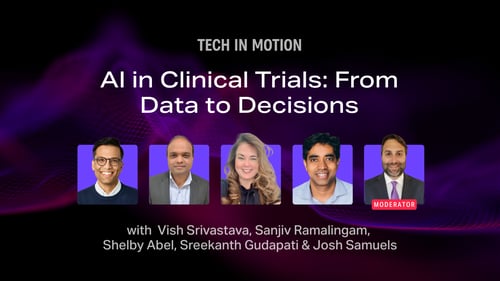

Clinical trials are evolving rapidly — and AI is at the center of the transformation. This conversation brings together biotech, pharma, and technology leaders to discuss how they are leveraging AI to accelerate clinical development, improve patient outcomes, and modernize the future of clinical trials.
Biggest Data Challenges
Clinical research does not suffer from a shortage of data. The challenge is making sense of the growing volume coming from an expanding number of sources.
Data silos and fragmentation remain significant obstacles. A single clinical trial can require sites and study teams to work across as many as 30 separate technology systems, according to Oracle, creating complex integration and reconciliation demands.
Traditional Electronic Data Capture (EDC) systems must increasingly connect with information from Electronic Health Records (EHRs) and electronic Clinical Outcome Assessment (eCOA) platforms, third-party vendors and other sources.
Wearables add another layer, continuously generating physiological and behavioral data that traditional trial systems were not designed to manage.
The real value comes from bringing those sources together so researchers can see a more complete picture of a patient’s progress through a study.
AI-generated insights also become more useful when information is viewed in context. Lab results should not be considered in isolation from EDC data. Protocol information needs to connect with study endpoints and review objectives.
Insights are only as good as the data that's underlying. So, you need a unified model, particularly for clinical research.”
Sreekanth Gudapati, SVP elluminate Services, eClinical Solutions
Unstructured data presents another major opportunity. Structured data such as International Classification of Diseases (ICD) codes can help identify potentially relevant patients, but those codes do not always reliably confirm that a patient actually has a particular condition. More definitive evidence may be buried in unstructured sources such as clinical notes, pathology reports, and other medical records.
Reviewing all of those records manually would be impractical at scale. AI can analyze the unstructured information alongside structured data to help determine whether patients meet specific clinical criteria, provided the system has been validated for that particular use case.

Practical AI Use Cases
Some of the strongest applications are not dramatic replacements for entire functions. They are focused uses of AI that remove repetitive work while keeping experts involved in important decisions.
One example is Study Data Tabulation Model (SDTM) data generation, the process of converting and organizing raw clinical trial data into the standardized SDTM format required for regulatory review and submission. Generative AI can create specifications that are then reviewed and approved by a person. Deterministic rules can generate the code after that approval.
That separation is important. AI assists with creating the specification while a human remains responsible for approving it. The code itself remains deterministic. The value is also measurable because organizations can compare the time traditionally spent developing specifications and programming against the AI-assisted process.
Another practical use involves trial summary metadata. AI can extract information such as primary outcomes and planned subject counts directly from a clinical trial protocol, the document that lays out how the study will be designed and conducted.
Then, instead of starting from a blank document, programmers can begin with a partially completed template.
Medical data review offers another opportunity. AI can support cross-functional review while helping generate queries and identify deviations. The technology reduces manual effort while experts remain responsible for determining whether the output is correct and what action should follow.

Industry leaders from X4 Pharmaceuticals, eClinical Solutions, Biogen, and Century Health discuss AI usage in clinical trials during a recent Tech in Motion event.
How Is AI Changing Collaboration?
Clinical research has traditionally relied heavily on handoffs between specialized teams.
AI is beginning to blur some of those boundaries. A domain expert might traditionally write a specification and pass it to a programmer. AI-assisted tools can allow the business expert to create an initial prototype before more complex work is handed over.
That changes the relationship between teams. Instead of moving work from one function to another, organizations can shift toward more continuous collaboration throughout the process.
The traditional flow of clinical data is changing as well. Standardized data that once moved primarily downstream toward analysis can now be refreshed more frequently and made available to a wider group of stakeholders. Medical teams can review standardized information earlier instead of waiting until later stages of the process.
Keeping AI Clinically Trustworthy
In clinical research, confidence in AI requires more than an accurate answer.
Systems need to be grounded in information that users are authorized to access. The context of the study matters. Traceability matters as well.
Explainability may not be enough in a regulated environment. AI systems also need to be inspectable. Organizations should be able to determine how an insight was produced, what information was used, and what human action followed.
AI does not understand real life, and when real life data comes in and it doesn't make sense, then the human in the loop still is required.”
Shelby Abel, Senior Director of Data Management, X4 Pharmaceuticals
Human oversight remains essential because real clinical data does not always behave logically. Unexpected visits or dosing events may make sense once the circumstances at a clinical site are understood. An AI system may recognize that something looks unusual without understanding why it happened.
Monitoring also cannot stop after implementation. A model that produces the right output today needs to continue doing so after a protocol amendment or months later. Validation should be treated as an ongoing responsibility rather than a one-time checkpoint.
The Next Five Years
Clinical operations and data management are likely to become much more strategically connected to technology.
Work that has historically been transactional will become part of a broader technology-enabled process. Cross-functional teams will play a greater role in developing standards and validating the AI models used throughout a study.
Unstructured information may also become much easier to use. Tasks such as literature review or protocol analysis could take a fraction of the time they require today.
Writing tasks such as preparing clinical study reports and other regulatory documentation are another area likely to change quickly, as AI can generate first drafts in minutes and allow medical and clinical experts to focus on reviewing, correcting, and refining the content rather than writing it from scratch.
That raises an important workforce question. If early-career professionals no longer learn by writing these documents from scratch, organizations will need to find new ways to build the expertise required to review AI-generated work effectively.
Evolution of Roles
AI is unlikely to eliminate the need for clinical data managers, statistical programmers, and other specialized professionals. It is, however, much more likely to change how they spend their time.
Programming workflows will become faster. Expectations around the time required to create tables and reports will change as AI removes some of the manual work.
Data management may shift toward reviewing AI-generated output and investigating unusual findings rather than coordinating as many manual review processes.
Some roles will also begin to converge. Professionals who understand both the technical and functional sides of clinical research will become increasingly valuable. Internal AI tools may also accelerate onboarding by giving new employees faster access to information that previously had to be passed down directly from experienced colleagues.
AI doesn't replace people. People using AI replace people that aren't using AI.”
Vish Srivastava, Co-Founder & CEO, Century Health
Ultimately, the advantage will not simply belong to organizations that have AI tools. It will belong to the people and teams that learn how to use them effectively.