
Organizations should not pursue AI simply because it is fashionable, nor should they chase each new model release as though the newest tool automatically solves business problems. The companies that succeed with AI will be the ones that focus on outcomes, understand AI’s limitations, and bring agentic capabilities directly into the core of their workflows.
McKinsey’s 2025 AI survey found that 62% of respondents say their organizations are at least experimenting with AI agents, but agentic AI is still not broadly scaled across most business functions.

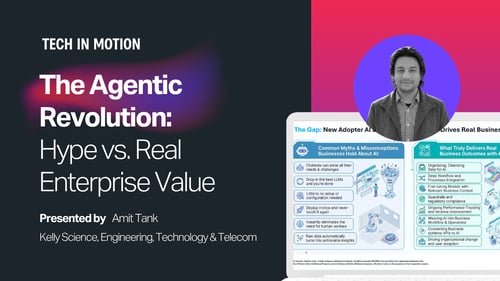

Agentic AI is everywhere—along with promises of autonomous agents, overnight enterprise transformation, and “10X” gains. Yet many organizations are still struggling to define their adoption path and value proposition. In this session, Amit Tank cuts through the hype and focuses on what actually works.
A Familiar Enterprise Pattern
Today’s AI moment has similarities to the early days of cloud computing. When cloud first entered the enterprise, many organizations treated it as a novelty or as an IT-only concern. Over time, cloud became a foundational business capability.
AI is following a similar path. It may look like a technology trend, but AI's real value emerges when it improves business outcomes such as cost savings, innovation, data-driven insights, and developer velocity.

Rather than chasing AI for the technology of it, go after the outcomes.”
Amit Tank, Kelly Science, Engineering, Technology & Telecom
Separate Hype from Reality
A critical distinction must be made between hype and reality:
• Chatbots do not solve every problem. Dropping in the best LLM does not solve a company’s problem by itself.
• AI is not a magic wand that can be deployed once and then left alone to generate value automatically.
• Data does not become actionable simply because AI is applied to it.
Successful adoption depends on the difficult, practical work of cleaning data, organizing it, building ETL pipelines, creating governance and embedding AI into real workflows.
That reality is one reason so many projects struggle to move past proof of concept. Gartner’s 2024 forecast warned that at least 30% of generative AI projects would be abandoned after proof of concept by the end of 2025.
Enterprise Agents Have Higher Stakes
That mindset is especially important in enterprise environments, where AI agents differ significantly from personal agents. Personal agents may be useful for convenience, scheduling, summaries, or individual productivity.
Enterprise agents must meet a higher standard. They require shared memory, long-term context, orchestration, auditability, governance, compliance, and clear ownership of data. In regulated industries such as telecom, oil and gas, insurance and financial services, these considerations are not optional. They are foundational.
Human Expertise Still Matters
AI does not remove the need for human expertise. In fact, the human factor becomes more important as AI becomes more powerful. Organizations need people who understand where AI stops and where judgment, domain knowledge and accountability begin. This is particularly relevant for professionals trying to grow their careers. AI expertise is not just about knowing tools. It is about understanding how to apply AI responsibly and practically within a specific business context.

Understand the Agentic Architecture
Agentic architecture can be understood by comparing it to a traditional computer system. In this model, the large language model acts like the CPU, context windows and vector databases function as memory and storage, tool integrations operate like device drivers, and the agent harness acts as the operating system.
This framework helps demystify agents. Rather than thinking of them as magical systems, businesses can understand them as structured workflows.
The Agentic Loop
A simple agentic loop begins when a user gives the system a message. The system remembers context, then responds or invokes tools such as weather lookup, currency conversion, or search. That loop sits at the heart of agentic AI across many providers and frameworks. The specific model may vary, but the underlying pattern of context, reasoning, tool use, and response is consistent.
Autonomous vs. Prescriptive Agents
Autonomous agents can be given a broad objective and decide how to proceed. Prescriptive agents are more tightly guided by defined workflows, institutional knowledge, and business rules.
In the enterprise, prescriptive agents are often more useful because companies operate within years or decades of process knowledge. Insurance claims, telecom operations, compliance workflows, and financial reviews are not open-ended creative tasks. They require agents to follow the logic of the business.
More People Can Build
Building agents is no longer limited to experienced coders. Visual platforms can allow non-technical business users to use agents without writing code. That does not mean deep technical knowledge is unnecessary in all cases, but it does mean more people can participate in AI transformation. As such, AI becomes a practice, not just a programming discipline.
Ground AI in Enterprise Knowledge
Retrieval augmented generation, commonly known as RAG, is another important enterprise pattern. RAG allows an agent to retrieve information from a defined knowledge base rather than relying only on general internet information or the model’s training data.
Domain expertise matters. AI enhances experts, but it does not make someone an overnight expert in a field they do not understand.
Amit Tank, Kelly Science, Engineering, Technology & Telecom
A RAG-based agent can search company documents, reports, policies, benefit guides, slide decks, or knowledge bases and return information grounded in the organization’s own content. This makes AI more useful, more relevant, and potentially more reliable.