
Like the rise of desktop computing, the internet, and cloud computing, AI is changing not just the technology stack, but the expectations placed on teams, leaders, and individual professionals.
One important distinction is that AI is not limited to IT. It is a companywide change management effort. Agents can be built and applied by HR, recruiting, sales, finance, operations, and other departments. That makes AI transformation broader than a technology rollout.
The scale of adoption is already significant. McKinsey’s 2025 global AI survey found that 88% of organizations now regularly use AI in at least one business function, up from 78% the previous year. However, most organizations remain early in their scaling journey, which reinforces the need to treat AI as an enterprise operating shift rather than a one-off technology project.

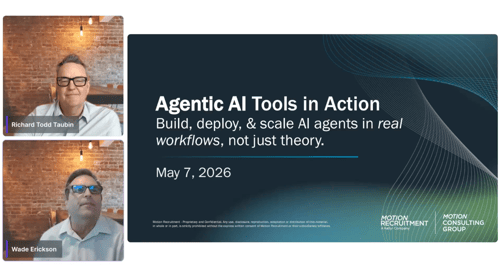

In this workshop, experts from Motion Consulting Group break down what enterprise AI transformation really looks like in practice. From agentic AI and automation to hiring trends and skill gaps, this session covers how companies are moving from experimentation to real impact.
Strategy Comes Before Tools
For leaders, the first lesson is to avoid starting with tools. The right starting point is strategy. Organizations need to identify where AI can create the greatest value and connect AI initiatives to business outcomes.
The technology itself comes later. The work begins with understanding which processes are repeatable, which are inefficient, which involve unstructured information and which could benefit from intelligent automation.
A tool-first approach carries real risk. Gartner predicted that at least 30% of generative AI projects will be abandoned after proof of concept by the end of 2025 because of poor data quality, inadequate risk controls, escalating costs, or unclear business value.

Start with strategy and alignment against business value. Tools come later.”
Wade Erickson @ MCG, a Kelly Company
Map the Work as it Really Happens
That process-first mindset is central to successful agentic AI adoption. Companies should begin by mapping how work actually happens today. Not how a standard operating procedure says it happens, but how data, decisions, and tasks move through the real business.
That means understanding where information starts, where it is managed, where it rests, and where bottlenecks occur. Only then can an organization determine where an agentic process could assist.
Measure What Matters
AI should be judged by measurable outcomes.
Cost savings, cycle time reduction, hours saved, revenue growth, conversion improvement, pipeline acceleration, and upsell opportunities are all examples of business measures that can help define value.
This is not entirely new. Robotic process automation has been used for years to automate structured work. What AI adds is the ability to work with unstructured data, such as transcripts, documents, emails, proposals, customer conversations, and knowledge assets. That opens the door to a much broader set of enterprise use cases.
Apply AI Inside the Value Stream
Proposal development is one practical example. Proposals that once took a week to write can now be drafted in hours using transcripts and client feedback. The value is not simply faster writing. The larger benefit is that the output can reflect what was actually discussed with the client, including details that may have been missed in handwritten notes. This illustrates how AI can enhance knowledge work when it is embedded into an existing value stream.

Treat Agents Like Teammates
Agents should also be viewed as part of business workflows rather than standalone novelties. In a sales process, for example, one agent might help identify and qualify leads, another might support discovery and another might help generate proposals.
The key is to align agents with defined stages of work and clear business goals. In that sense, agents should be treated somewhat like employees. They need a role, a purpose, guardrails, and a manager who understands how to evaluate their output.
Redefine Human Value
This also changes the role of people. AI should not be viewed only as a replacement tool. Instead, it creates a shift in human value. Experienced professionals may spend less time doing repetitive work and more time reviewing, validating, and guiding what AI produces. The human becomes the expert in the loop.
Experienced people are not being replaced. Their value shifts to reviewing, validating, and guiding what AI produces.”
Richard Taubin @ MCG, a Kelly Company
Start With Practical Wins
For enterprise rollout, a crawl, walk, and run approach is the most practical path. Organizations should not begin with the most regulated, politically sensitive, or complex department. They should select two or three high-value but lower-risk domains where they can produce visible wins.
These “lighthouse” domains help the organization learn, demonstrate value, and build confidence. Once early pilots prove useful, teams can expand into adjacent areas and eventually tackle more complex and regulated workflows.
Avoid the AI Bottleneck
Organizations should also be thoughtful about how they structure AI leadership and delivery. A center of excellence can provide strategy, governance, standards, and leadership, while a delivery center focuses more on implementation.
However, a centralized AI group can easily become a bottleneck if every project must flow through one team. A virtual model, drawing subject matter experts from across teams and then sending that knowledge back into the business, can help spread AI practices more effectively.

Motion Consulting Group helped a Biotech company increase accuracy and insights to their data models. Over 6 months, trained the models and fine-tuned parameters to achieve a 98% global accuracy rate.