
Boston has never been a typical tech market. It doesn’t rely on a single dominant industry, but rather, Boston’s strength has always come from convergence: software meeting science, research becoming product, and innovation moving from the lab into real-world impact.
In 2026, that convergence is accelerating. Artificial intelligence is no longer a standalone discipline in Boston. It is being embedded into life sciences, healthcare, robotics, and financial services at scale. The result is a tech ecosystem that is both highly specialized and deeply resilient
Talent Density
Boston remains one of the most concentrated tech talent markets in the United States. The Boston-Cambridge-Nashua metro area employs over 130,000 professionals in computer and mathematical occupations, including more than 55,000 software developers.

The Boston metro area currently supports roughly 20,000 to 35,000 active IT and technology job postings at any given time, making it one of the most robust and diverse tech hiring markets in the U.S.
The region consistently ranks among the top U.S. markets for tech degree production, driven by institutions like Massachusetts Institute of Technology and Harvard University, along with a dense network of research institutions and teaching hospitals. This creates a steady pipeline of engineers, data scientists, and researchers who are not only technically proficient but also experienced in solving complex, real-world problems.
AI Amplifying Boston’s Core Industries
Rather than displacing existing industries, AI is enhancing them. Nowhere is this more evident than in life sciences and healthcare, where Boston already leads the nation in research and development talent. AI is being applied to drug discovery, clinical trials, diagnostics, and patient data analysis, transforming workflows that were previously a slow, manual process.
Recent workforce research in Massachusetts shows that AI-related job demand in sectors such as life sciences and education has surged in recent years, with some categories seeing growth of more than 50%.
Watch our "Agentic AI Tools In Action" workshop featuring demos, tools, and real‑world applications that show how agentic AI works in production environments.
Production-Ready Systems
Boston organizations are no longer satisfied with proof-of-concept models or isolated use cases. They want systems that are reliable, scalable, and integrated into core business processes. That shift is driving demand for technologists who understand not just machine learning, but also data infrastructure, cloud architecture, security, and governance.
With many Boston industries living in highly regulated environments, the most valuable candidates in the area are the ones who can bridge the gap between advanced AI capabilities and real-world deployment.
Healthcare systems must ensure patient privacy. Financial institutions must manage risk and compliance. Life sciences companies must meet strict regulatory standards. In these contexts, AI cannot simply “work”; it must be explainable, auditable, and secure.
Life Sciences
Boston consistently ranks at or near the top nationally for life sciences research and manufacturing talent, anchored by companies such as Moderna and Biogen. But what is different in 2026 is how tightly integrated these organizations are with software, data, and AI.
Software engineers are building platforms for genomic analysis. Data scientists are modeling clinical outcomes. AI specialists are accelerating drug discovery timelines.
Even traditional lab environments are becoming increasingly digitized, requiring automation, data engineering, and advanced analytics.
For tech talent, this creates a unique opportunity. Boston is one of the few markets where combining software expertise with domain knowledge in biology, healthcare, or chemistry can dramatically increase career value.
Robotics
The presence of research institutions, combined with a long history of engineering innovation, has allowed the region to maintain leadership in robotics, automation, and physical AI systems. Boston companies continue to push the boundaries of what machines can do in real-world environments.
Computer systems design continues to be a major driver in tech hiring, and scientific research and development is one of the fastest-growing sectors in the city. This dual strength is what enables Boston to lead in areas like robotics, advanced manufacturing, and AI-driven physical systems, fields that require both theoretical knowledge and practical engineering execution.
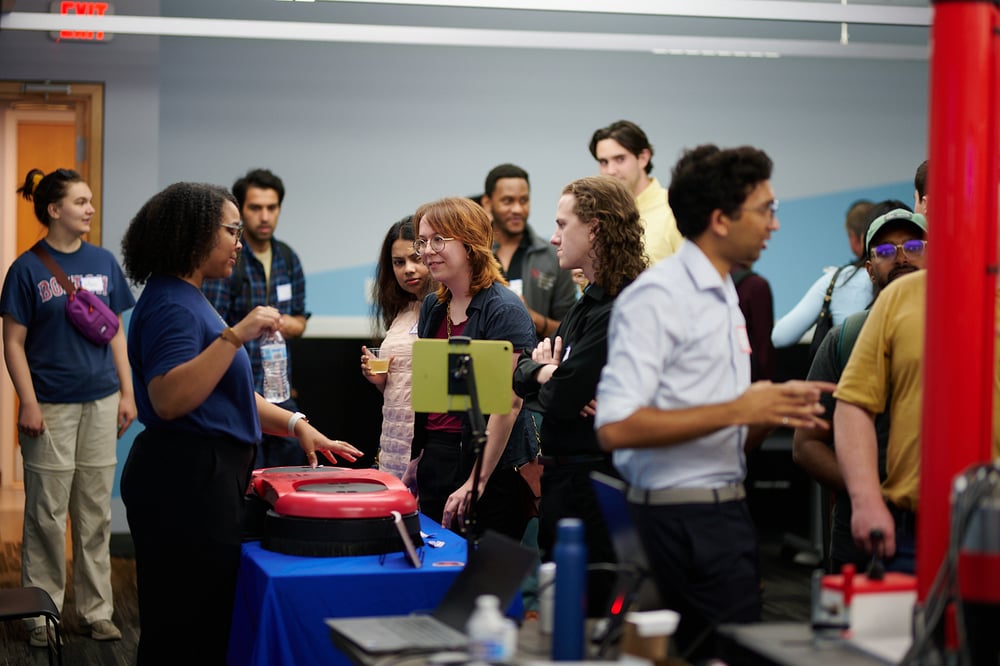
Tech in Motion Boston brought the community together for an evening full of live demos, fast-paced lightning talks, and interactive exhibits featuring Automated Tire, Fleet Robotics, Rise Robotics, Symage by Geisel Software, Square Robot, Ubiros, and more.
In-Demand Tech Jobs
| Software Developers and Application Engineers | Cybersecurity Analysts and Security Engineers |
| Data Engineers and Data Scientists | Systems Analysts and Solutions Architects |
| AI and Machine Learning Engineers | Bioinformatics and Healthtech Specialists |
| Cloud and Platform Engineers | Robotics and Automation Engineers |
What This Means for Tech Talent
This is not a market built on generalist software development alone. It is a market that values depth, specialization, and the ability to apply technology in complex, high-stakes environments.
Candidates who understand how to operationalize AI, work with regulated data, and bridge technical and domain expertise will find the greatest opportunities.
Those who can combine software engineering with knowledge of healthcare, life sciences, finance, or robotics will be especially well-positioned.
Not a single dominant sector, but a network of industries transformed by technology. Not just innovation for its own sake, but innovation tied directly to real-world outcomes.
Top Tech Salaries in Boston
Software Roles
Software Architect: $168,000 – $203,000
Back End Developer: $154,000 – $198,000
AI & Data Roles
Machine Learning Engineer: $172,000 – $226,000
AI Engineer / LLM Engineer: $159,000 – $208,000
Senior Data Engineer: $150,000 – $1883,000
Cybersecurity Roles
Security Engineer: $140,000 – $165,000
Application Security Engineer: $147,000 – $179,000
Security Operations (SOC) Analyst: $110,000 – $138,000
